Newsletter
Exclusive expert tips, customer stories and more.
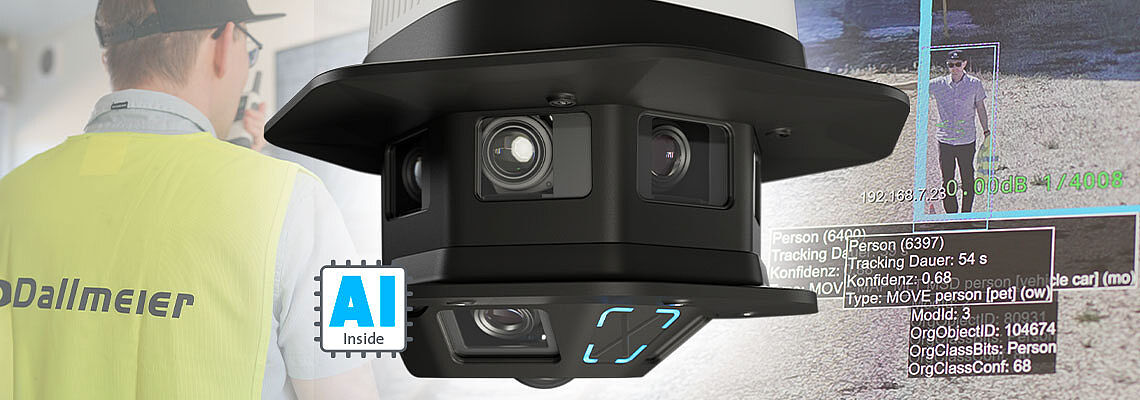

Artificial intelligence plays a central role in modern security technology at Dallmeier. The company consistently follows a “Made in Germany” and “AI trained by Dallmeier” approach: AI models are trained on Dallmeier’s own servers in Regensburg, Germany, and optimized under real-world conditions at the company’s dedicated test site. Dr. Maximilian Sand-Kraus, Team Leader Artificial Intelligence at Dallmeier, explains the background and advantages of this approach.
How important is AI in your development efforts, and how do you ensure quality and transparency?
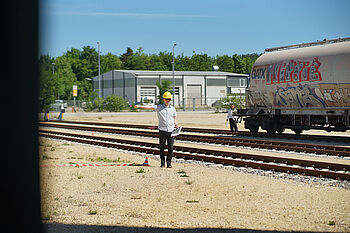
Artificial intelligence is not a short-term trend for us; it is an integral part of our technological development. We ensure quality and transparency by maintaining full control over the entire development and training process. Rather than relying solely on large, generic datasets, we deliberately expand our data foundation with high-quality, application-oriented data that is processed exclusively on our own servers in Germany.
The quality of training data is a critical factor in building powerful AI systems. This is exactly where our approach begins. At our dedicated test site in Regensburg, we can simulate real operating conditions and specific application scenarios in a controlled environment. This allows us to optimize our AI specifically for different market requirements and customer needs across a wide range of security applications. The result is practical and highly reliable AI solutions.
All training processes take place entirely within our own infrastructure in Germany. Sensitive data never leaves Dallmeier’s controlled environment and is never transferred to external cloud systems. At the same time, our training process is specifically designed to work seamlessly with the AI chips integrated into our cameras. This creates a powerful, secure AI solution that is precisely aligned with our system architecture.
This holistic approach ensures a high level of practical relevance and reliability while providing the foundation for trustworthy AI. In short, our approach is based on “AI trained by Dallmeier.”

“Artificial intelligence is not a short-term trend for us; it is an integral part of our technological development.”
Dr. Maximilian Sand-Kraus, Team Leader Artificial Intelligence at Dallmeier
What does “AI trained by Dallmeier” mean in practice?
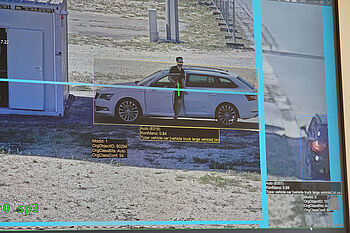
Our neural networks are trained entirely in-house and then deployed to the cameras. The camera itself only executes the trained model; there is no automatic self-learning during operation.
Instead, the pretrained neural network uses its learned knowledge to analyze previously unseen live images and reliably detect objects such as people, vehicles including cars and trucks, and animals.
This clear separation between training and deployment ensures a high degree of stability and predictability in system behavior. It also enhances protection against manipulation because the AI model cannot be compromised by manipulated operational data while in use.
This approach is also highly relevant from a regulatory perspective. System behavior is predefined and does not change dynamically during operation, which is a key consideration in the context of current EU AI regulations.
How does this approach differ from traditional methods such as pattern matching?
One of the key differences lies in the underlying principle. Traditional pattern-matching methods typically rely on predefined characteristics and reach their limits more quickly when faced with varying or previously unknown appearances. Neural networks, on the other hand, learn abstract features and relationships from data during training. As a result, they are able to generalize. This means they can recognize an “unknown person” as a person even if that specific individual was never part of the training dataset. This capability is essential for reliable operation in real-world, dynamic environments.
How flexible is your system when it comes to future requirements?
Our systems are designed so that additional analytics functions or enhanced neural networks can be added whenever required. New capabilities can be delivered through encrypted updates and activated as needed. This ensures long-term adaptability without requiring changes to the existing infrastructure.
Is your AI solution scalable?
Our solution is highly scalable. Image analysis using neural networks takes place directly in the camera. This means no additional analytics servers are required, whether on-premises or in the cloud. As a result, concerns about cloud-based data privacy do not arise in the first place.
This decentralized approach not only reduces system complexity but also enables straightforward expansion, for example by adding additional cameras without having to resize central resources.
How compatible is your AI with existing security platforms?
Integration into existing security infrastructures is a key consideration. Detected objects and analytics events are provided through standardized ONVIF interfaces. In addition, our AI solutions can be used not only with our own video management software, Hemisphere® SeMSy®, but are also compatible with third-party platforms from companies such as Genetec, Milestone, Advancis, and Octave. This enables customers to continue using their existing systems while benefiting from AI-powered video analytics.
How reliable are the analytics results, and what role does the human operator play?
Our AI delivers a high level of accuracy and reliability. It is designed to support decision-making processes, not replace them. In practice, this means that a supervisor can make informed decisions based on generated analytics events without having to continuously monitor every camera stream. The AI significantly reduces workload and directs attention to relevant events.
Does Dallmeier use “human-in-the-loop” approaches?
Yes, in a clearly defined manner. Our AI does not make autonomous decisions. It is used for object detection and event generation. The actual assessment and decision-making process always remains with the human operator. For example, users can define rules such as: “If a person crosses a specific line, an event is triggered.” The event is then reviewed and evaluated by an operator. This ensures that control always remains with the user.
What measures do you take to minimize risks such as model drift or bias?
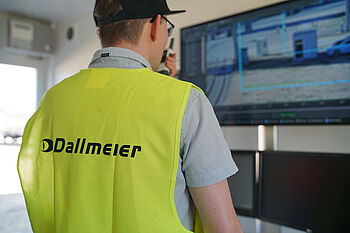
We use several approaches. First, feedback from projects and users naturally contributes to ongoing development. Second, we regularly retrain our models using new, carefully validated data. A particular focus is placed on the quality of training data. We deliberately use balanced datasets to avoid systematic bias and conduct extensive testing and evaluation procedures. This ensures that our AI remains reliable and stable over the long term.
Which AI analytics functions are currently available to users?
Our AI portfolio includes a wide range of specialized analytics functions for different application scenarios. Examples include the AI Perimeter App, which enables the monitoring of security areas along fences and perimeters. Its specially trained neural network can detect even well-prepared intruders, including those using unusual body postures, movement patterns, or camouflage clothing. The AI Extended Tamper Detection App identifies attempts to manipulate cameras, ranging from direct interference such as repositioning the camera to deliberate disruptions caused by light sources or fog. For high-traffic areas, the AI High Resolution Counting App provides highly accurate counting of people and vehicles. In addition, the AI Person Attributes App identifies characteristics such as clothing color and significantly accelerates the investigation of recordings. These applications demonstrate how our AI is specifically designed for real-world use cases and provides effective support for operators.
From your perspective, what is the key advantage of “AI trained by Dallmeier”?
The key advantage lies in the combination of data quality, technological control, and transparency. We train our AI on our own infrastructure in Germany and use practical training data derived from realistic application scenarios. This results in AI solutions that are stable, secure, and reliable. That is the foundation of trust – and trust is a decisive factor, especially in security-critical applications.
